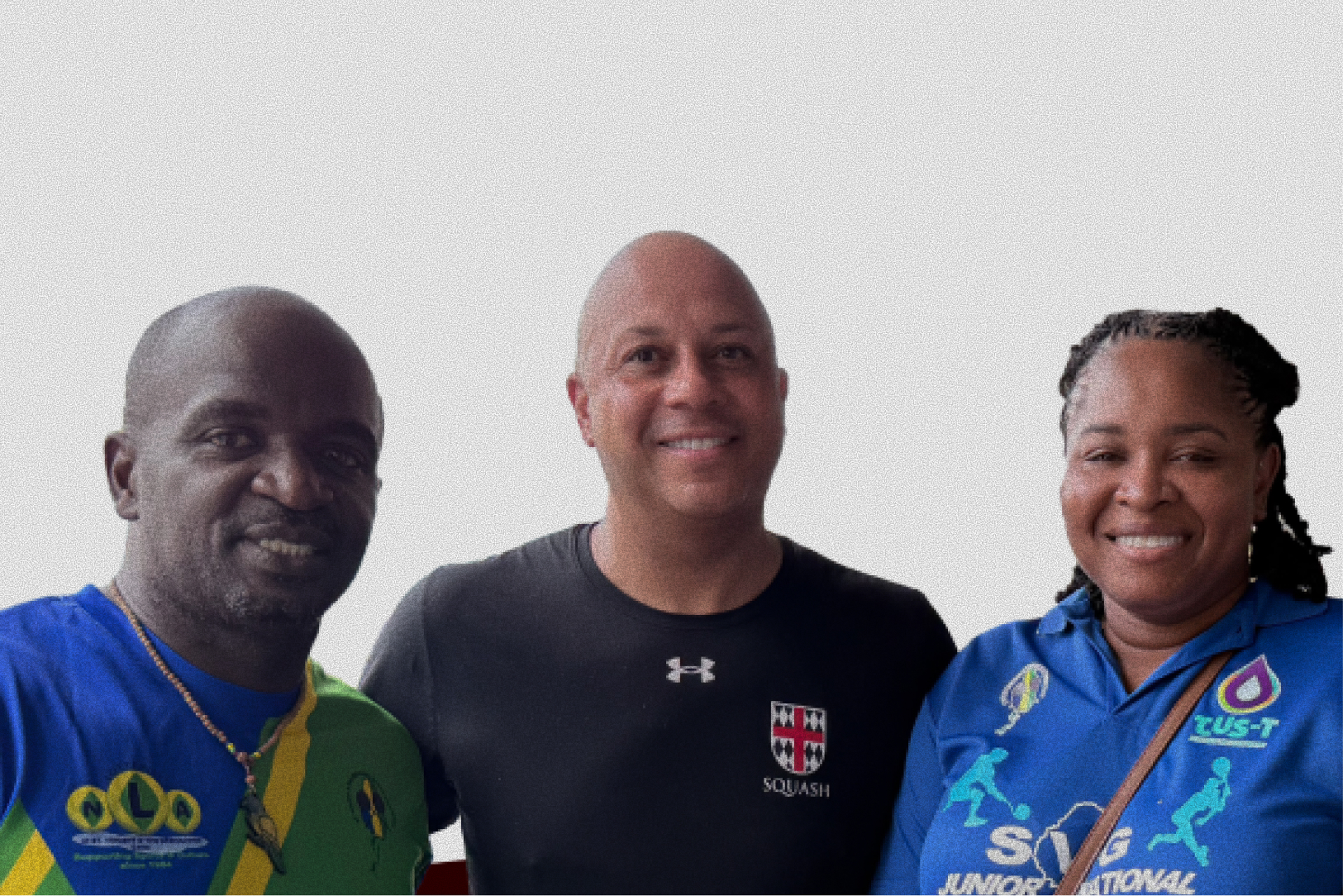
Earlier this year, Weusi awarded Pat Cosquer the Community Impact Grant to support his attendance at the Caribbean Area Squash Association (CASA) Junior Championships in the British Virgin Islands. The intention was not simply to enable travel, but to create the opportunity to spend time within the Caribbean squash community, strengthen existing relationships, and better understand the aspirations of the families, coaches, and associations shaping the next generation of players.
When Pat returned, Weusi Founder and Strategic Director James Dodson sat down with him to reflect on the experience. Their conversation moved well beyond tournament results. Instead, it explored what Pat had learned by being present, listening carefully, and experiencing CASA from within the community itself.
Although Pat has spent much of his career coaching Caribbean players and helping families navigate educational opportunities in the United States, attending this CASA offered a perspective he had not experienced before. The relationships he had built over many years suddenly had a setting. He was able to see the environments where players developed, meet the families who supported them, and better understand the communities that had shaped so many of the young people he had worked with throughout his career.
Looking back on the week, it was not a particular match that remained with him. It was the atmosphere.
“The biggest takeaway was meeting the families,” he reflected.
The squash was played with the intensity expected of any international championship. Players competed with pride, every country wanted to perform well, and the standard of play reflected the importance of the occasion. Yet alongside that competitiveness was an unmistakable sense of togetherness. Parents watched matches beyond those involving their own children. Coaches spoke openly with colleagues from neighboring countries. Players who had become friends through previous tournaments continued to support one another, even while representing different flags.
For Pat, that sense of community distinguished CASA from many of the environments he has experienced elsewhere.
The tournament itself was conducted in conditions that demanded resilience. Courts sat outdoors beneath the Caribbean sun, with players, families and coaches moving between venues throughout the day. The physical setting naturally encouraged people to spend time together. Conversations continued between matches, meals were shared, and evenings became opportunities to reconnect before another day of competition began. Rather than existing as separate groups moving through the same event, families, officials and athletes became part of a shared experience.
As Pat met parents, coaches and federation leaders from across the Caribbean, discussions consistently returned to opportunity. Families wanted to understand how young people might continue their education while pursuing squash. Coaches wanted to know how more Caribbean players could gain access to boarding schools and universities abroad. Federation leaders introduced Pat to promising players from neighbouring countries and encouraged conversations that extended well beyond their own programs.
Rather than focusing exclusively on the future of one child, many conversations centred on how more young people from the region could benefit from similar opportunities. Pat found that association leaders and coaches were often just as willing to advocate for talented players from another island as they were for athletes within their own programs.
That openness reflected a shared understanding that expanding opportunities for one player could ultimately strengthen Caribbean squash as a whole.
One discussion with a father from Guyana remained particularly memorable. His son was attending one of the country’s strongest schools, performing well academically and developing successfully as a player. He questioned whether leaving home for an American boarding school necessarily represented a better path. It was a thoughtful reminder that educational opportunity cannot be reduced to a single model.
For some families, studying abroad offers greater structure, wider networks and experiences that may not be available at home. For others, remaining within a strong educational environment before pursuing university internationally may be the more appropriate decision. As Pat reflected afterwards, meaningful guidance begins by understanding the aspirations and circumstances of each family rather than assuming that every pathway should look the same.
Many of the families Pat met did not speak about international education as a permanent departure from home. Instead, they described it as an opportunity to acquire knowledge, experience and relationships that could eventually benefit their own communities. Throughout the Caribbean, Pat encountered coaches, administrators and former players who had studied overseas before returning to contribute to the sport, their professions and their countries.
Those stories reinforced something Weusi has long believed.
Travel is most meaningful when it broadens perspective while deepening one’s connection to home.
Pat’s own experiences allowed him to contribute to those conversations with credibility. Over the years he has coached numerous Caribbean athletes, many of whom have gone on to complete university degrees, build successful careers and remain active within squash. For younger families considering similar decisions, those examples offered reassurance that meaningful pathways already exist. They also demonstrated that;
success can be measured not only by personal achievement, but by the ability to invest that experience back into the communities from which it came.
The visit also highlighted the realities that many associations continue to navigate. Resources are limited, and difficult decisions must often be made about which young athletes receive support to travel, compete or access further opportunities. Behind every successful player stands a network of families, coaches, volunteers and administrators who continue to create possibilities despite those constraints.
Those efforts are seldom visible from tournament results alone, yet they form the foundation upon which future generations are built.
Reflecting on the experience, it became clear that the value of the Weusi Community Impact Grant cannot be measured solely by the journey itself. Its purpose was to create the opportunity to listen, strengthen relationships, and better understand a community from its own perspective.
What Pat encountered was not a region searching for direction through squash. He encountered communities with established traditions, committed families, experienced coaches and generations of people who continue to invest in one another through the game. The experience served as a reminder that meaningful partnerships begin with understanding before action. They are built through trust, shared purpose and a willingness to recognize the strengths that already exist.
Those are the foundations upon which enduring pathways are built. They are also the principles that continue to guide Weusi’s commitment to supporting communities where sport creates opportunities that extend well beyond the court.